African food sourcing for U.S. distributors.

Know the business case.
Then load the container.
Know the businesscase. Then…Load the container.

Source African food inventory. Coordinate FDA readiness, track your shipment and use what sells to plan your next order.

GloSource

Illustrative demo
01 / CONTAINER ECONOMICS

Plan the economics.

Capital required*$30,000
Expected sales$55,000
Expected gross profit$25,000

Shift capital between garri and spice mix. This example holds each product’s sales-to-cost ratio constant.

More spice mixMore garri
Original mix · $7,000 garri / $5,000 spice mix
Expected gross profit by product
Garri
$8,500
Fufu corn
$7,000
Plantain chips
$5,000
Dried vegetables
$3,500
Spice mix
$1,000
View product costs and sales assumptions
Illustrative USD values, not current prices or customer results.
ProductLanded costExpected salesGross profitSell-through
Garri$7,000$15,500$8,500Fast
Fufu corn$8,000$15,000$7,000Fast
Plantain chips$6,000$11,000$5,000Fast
Dried vegetables$4,000$7,500$3,500Very slow
Spice mix$5,000$6,000$1,000Slow
Total$30,000$55,000$25,0005 products

Sell-through labels are qualitative assumptions. Gross profit excludes downstream expenses, financing and taxes.

*Capital equals modeled landed cost in this example.

02 / SHIPMENT VISIBILITY

Track execution.

Container illustration from the GloSource shipment dashboard
0%Loading plan ready
SourceLoadShipReceive

Illustrative progression, not live shipment data.

Illustrative business case, not actual customer results. Gross profit excludes downstream operating expenses, financing costs and taxes. Expected results are estimates, not guarantees.

Built in the trade

Built from real trade.

Experience and relationships across the Africa–U.S. food corridor.

OPERATING EXPERIENCE2019onwards

Trade experience through
Abunde Foods.

DISTRIBUTION RELATIONSHIPS12+

U.S. warehouses

Relationships across food import and distribution.

MANUFACTURER NETWORK50+

Manufacturers

FDA registration and compliance monitored across Cameroon and Nigeria.

Meet the people behind your shipment
Start with the right question

A product list is not a sourcing strategy.

You know the products you want. Gloway helps you decide the mix and quantities around landed cost, expected sales, available capital and FDA compliance.

THE STARTING POINT

“300 cartons of this. 200 of that.
Fill the remaining space.”

THE BUSINESS CASE

Why these products?
Why these quantities?
What could they earn—and how quickly could they sell?

A typical sourcing conversation, illustrated.
The sourcing decision

Your container has to pass two tests.

01 / ADMISSIBILITY

Can it clear?

Gloway coordinates FDA compliance: manufacturer and facility registration checks, packaging, labeling and documentation reviews. A shipment must meet applicable U.S. requirements before price can create value.

02 / ECONOMICS

Can it pay?

Model landed cost, selling prices and demand before choosing quantities. Inventory needs to sell, not just arrive.

The product behind the process

Keep the numbers connected
to the work.

See how shipment funds are allocated and which supplier balances still need attention.

01 / CONTAINER ECONOMICS

Follow the capital
behind the cargo.

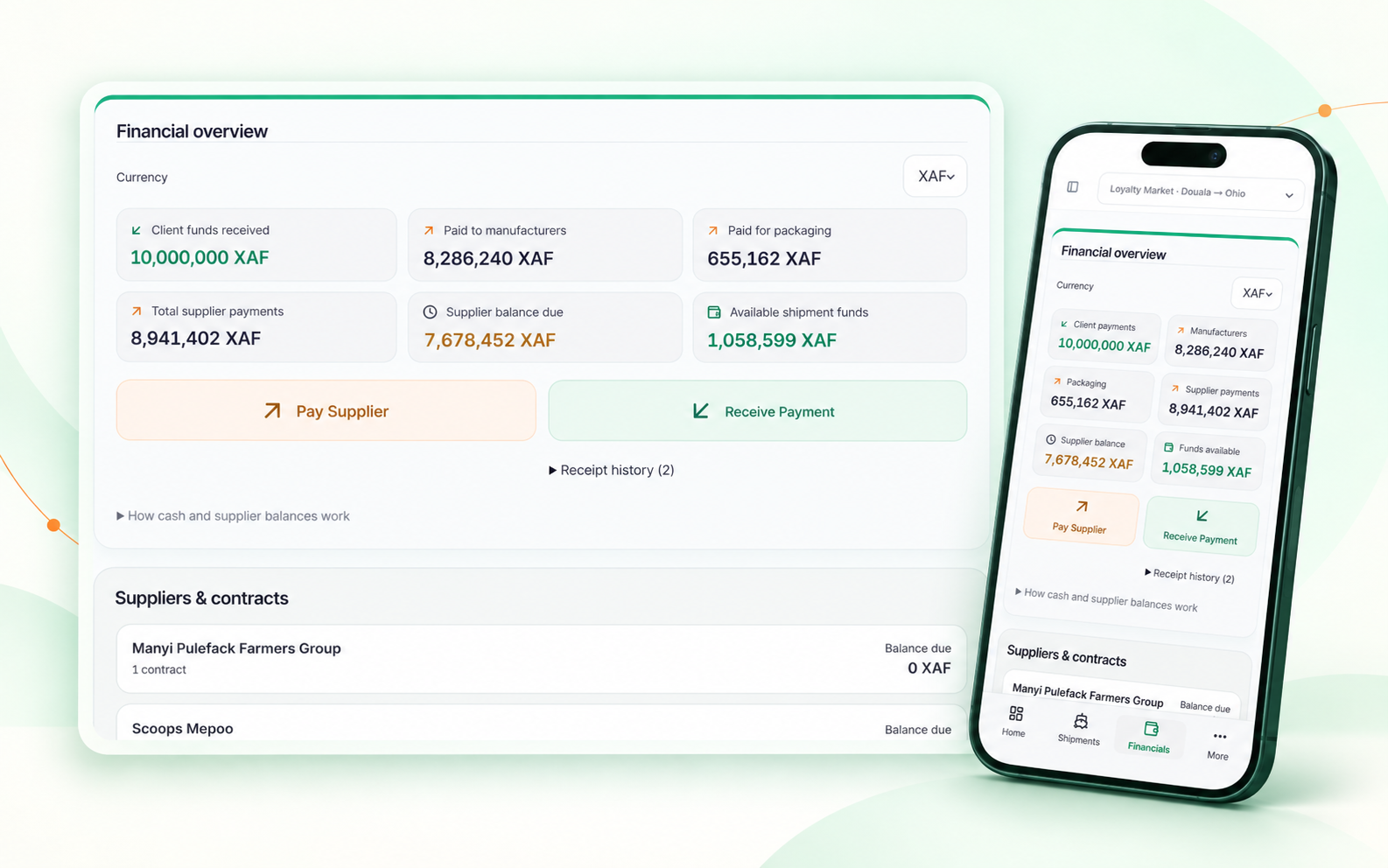
Track client funds, supplier payments and outstanding balances against the approved sourcing plan.

Understand profit-led sourcing
GloSource financial overview with client funds, supplier payments and outstanding balances
02 / SHIPMENT VISIBILITY

See the plan.
Follow the progress.

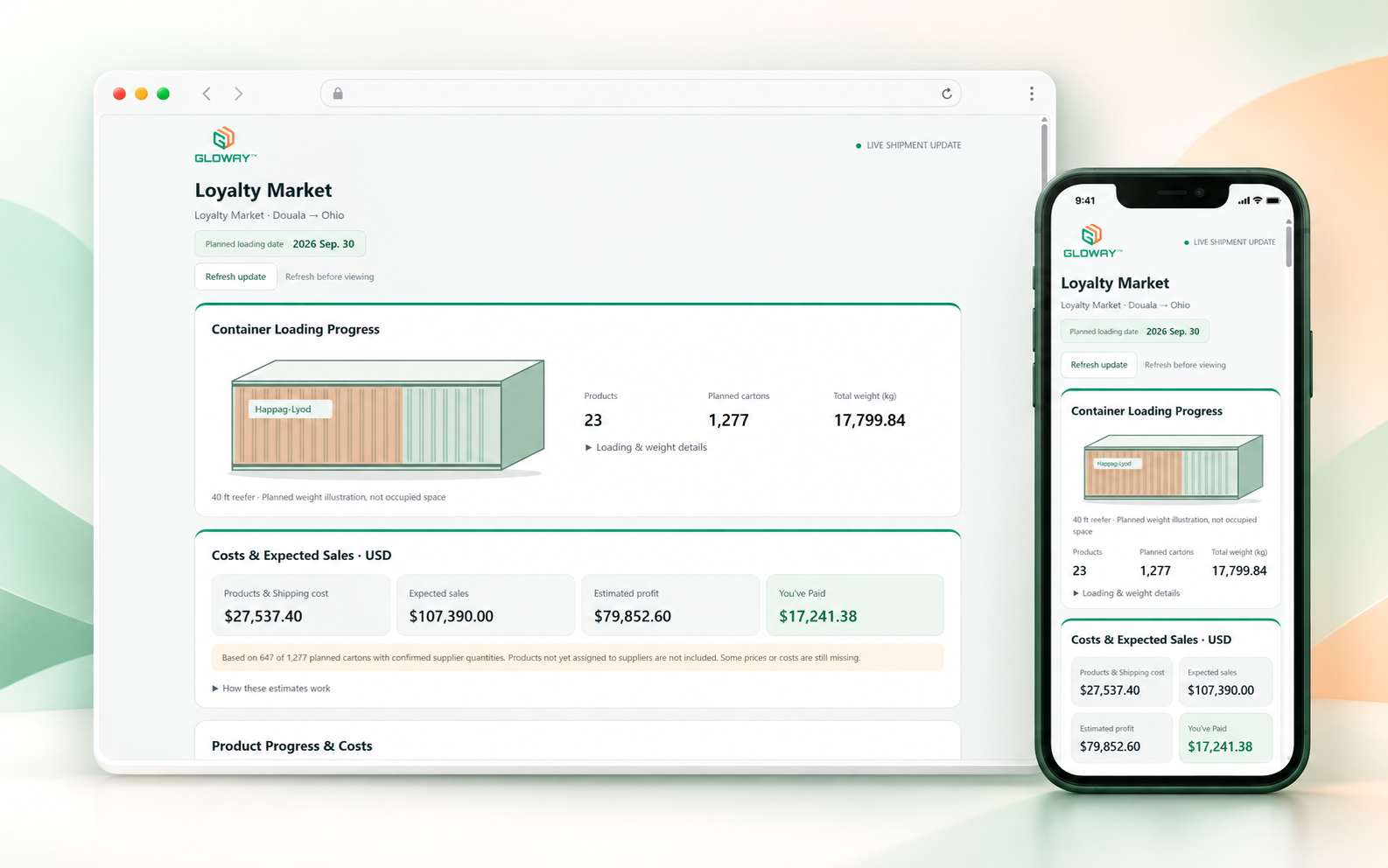
Keep product quantities, loading plans and shipment progress connected to the approved sourcing plan.

GloSource dashboard with container loading progress, planned products, cartons, weight, costs and expected sales
Animation demo0%Ready to load

Original product dashboard with an illustrative container-fill animation. The animation is not live shipment data or a packing calculation; dashboard figures remain the supplied snapshot.

Product visuals supplied by Gloway. Financial projections shown within them are estimates and may reflect incomplete transaction inputs.

One connected sourcing cycle

From the first decision
to the next reorder.

GloSource connects the planned economics with the work of getting inventory to market. You review and approve the plan before execution.

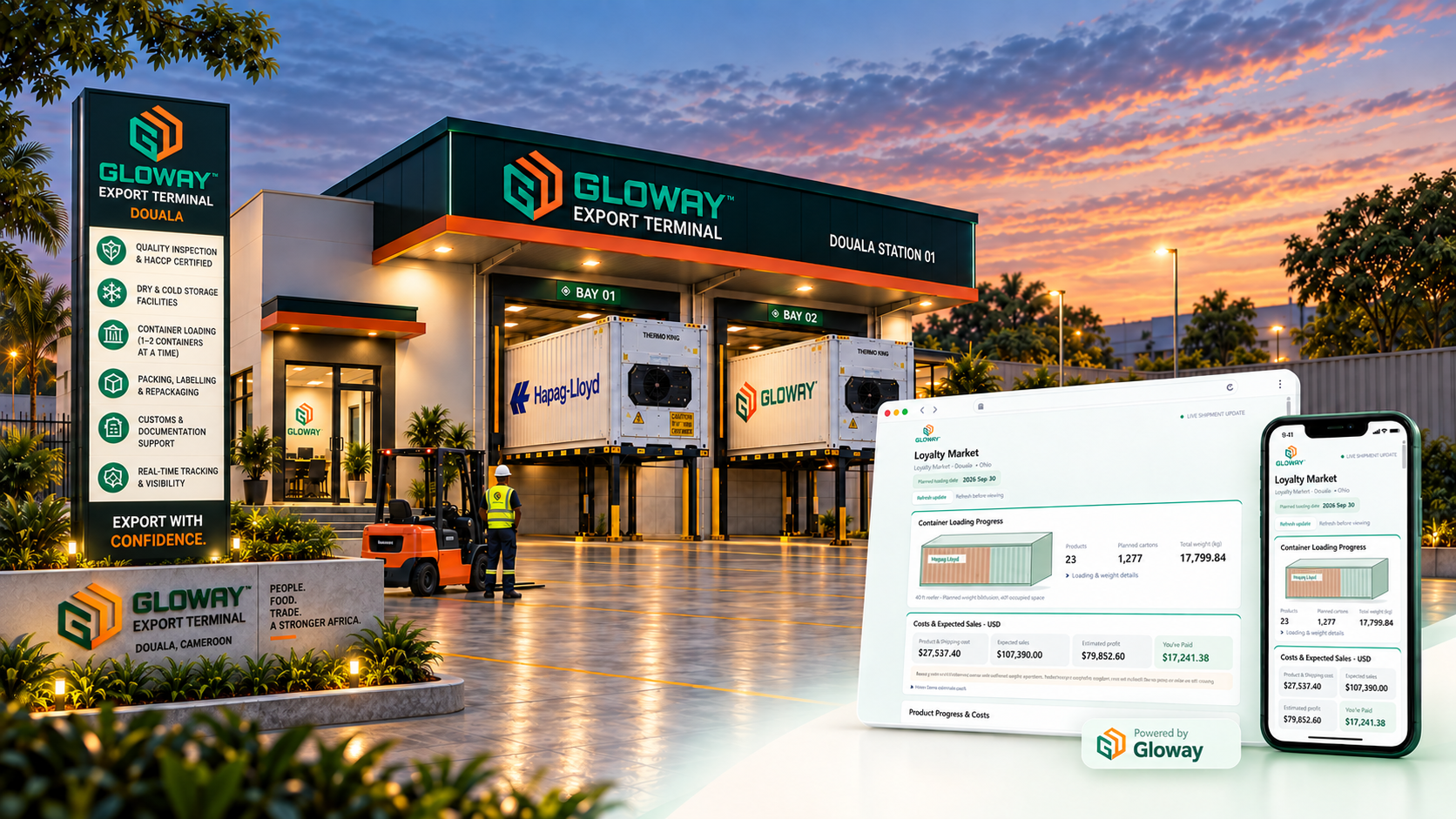
Concept view of Gloway’s export terminal, showing container loading areas, warehouse and delivery vehicles
ManufacturersContainerU.S. warehouseNext order
Gloway export terminal concept. Facilities and certifications shown are illustrative.
01

Plan

Model landed cost, expected sales and the product mix within your budget and capacity.

02

Source

Review manufacturers, specifications, compliance needs, production and quality control.

03

Move

Coordinate consolidation, documentation, loading and shipment milestones.

04

Sell

Connect eligible inventory to participating retailers and bulk buyers through GloCard.

05

Reorder

Compare the plan with what sold. Use the evidence to shape the next sourcing cycle.

Customer stories · sample drafts

Gloway in practice.

Examples of the decisions Gloway helps distributors and manufacturers make.

Draft examples for review. The scenarios and outcomes below are assumed, not verified customer results. Customer names and actual figures will be added after confirmation.

01 / Profit-led sourcing

A better loading plan within the same budget.

$8,000lower planned landed cost

Assumed outcome · $78,000 → $70,000

Compare supplier quotes and product quantities before committing capital.

Read the case study
The challenge
A U.S. diaspora food distributor had a familiar product list, but no clear view of the full landed cost or which products deserved more container space.
What Gloway did
Compared supplier quotes, packaging, freight and destination costs. Reviewed expected sales and adjusted the quantities before the loading plan was approved.
The outcome
In this sample, the revised plan reduced expected landed cost by $8,000, or 10.3%, while retaining the distributor’s priority products.
What supports this result?

For the final case: original and approved loading plans, comparable quantities, supplier quotations and a complete landed-cost breakdown. Distinguish planned savings from actual paid costs.


02 / FDA readiness

Resolve readiness gaps before the shipment leaves.

5 gapsaddressed before dispatch

Assumed outcome · readiness coordination

Coordinate facility information, labeling and shipment records before dispatch.

Read the case study
The challenge
A manufacturer was ready to supply a U.S. distributor, but facility information, product labels and shipment documentation needed a coordinated review.
What Gloway did
Built a readiness checklist, coordinated the facility registration and U.S. agent details, and worked with the manufacturer and importer to resolve labeling and documentation issues.
The outcome
In this sample, five identified gaps were addressed before dispatch, with the supporting records organized for the importer’s review.
What supports this result?

For the final case: dated readiness checklist, registration records, revised labels and documentation. FDA registration is not product approval; readiness support does not guarantee admission.

03 / Sell-through and reorders

Use sales evidence to plan the next shipment.

4 weeksshorter sell-through period

Assumed outcome · 16 weeks → 12 weeks

Use sales and remaining stock to adjust the next container mix.

Read the case study
The challenge
A distributor repeated the previous container mix even when some products sold quickly and others kept cash tied up in the warehouse.
What Gloway did
Connected sales and remaining stock to the next sourcing plan. Increased quantities of proven sellers and reduced slower products within the available capital.
The outcome
In this sample, a comparable shipment sold through in 12 weeks instead of 16—a 25% shorter sales cycle. Cash collection would be measured separately.
What supports this result?

For the final case: dated warehouse receipts, comparable product mixes, sales records and stock balances. Define sell-through consistently and account for seasonality and price changes.

The infrastructure thesis

Each sourcing cycle informs the next.

Gloway is building the feedback loop between supply, compliance and actual sales—so the next order starts with better information.

Read our infrastructure thesis
Operating focus Sourcing, compliance coordination and shipment records.Building next Deeper connections between demand, sourcing decisions and repeat orders.
Three inputs. One sourcing decision.Your next container planMix · quantities · timing

Supply intelligence

What can be supplied, at what price and when.

Compliance intelligence

What the facility, product and destination require.

Demand intelligence

What sells, how quickly and what to reorder.

Before you start

A few practical questions.

Do I need final quantities to start?

No. Share the products or categories, budget, destination and priorities. Determining a suitable mix and quantities is part of the planning work.

Are the profit projections guaranteed?

No. Results depend on sourcing costs, freight, demand, selling prices, spoilage and other factors. The business case makes assumptions explicit so you can review the decision.

Who is responsible for import compliance?

Gloway coordinates supplier verification, documentation and compliance support. Importer-of-record and regulatory responsibilities depend on the product and transaction agreement. Facility registration does not mean FDA product approval.

What is GloCard?

GloCard helps participating warehouses connect eligible inventory with retailers and bulk buyers. Buyer participation and inventory availability vary.

Does Gloway provide financing?

Financing is part of the longer-term infrastructure thesis. Any available arrangement must be confirmed separately; requesting a sourcing plan is not a financing application.

Before your next container,
start with the business case.

Bring your market, product priorities and budget. Let the quantities follow.

Plan your container